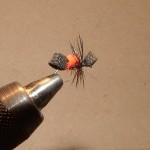
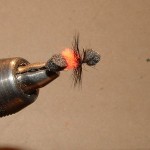
Foam Ant
Hook: Tiemco 102Y #16-#18
Body: Black Closed Cell Foam
Indicator: Hi Viz Dark Pink
Hackle: Black
Foam Ant
Hook: Tiemco 102Y #16-#18
Body: Black Closed Cell Foam
Indicator: Hi Viz Dark Pink
Hackle: Black
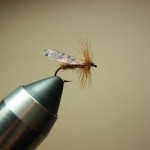
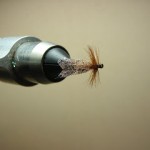
Web Wing Caddis
Hook : Tiemco #100 Size 10 – 20
Body : Ice Dubbing Rusty Brown
Wing : Web Wing Mottled Brown
Hackle : Brown Hackle
I saw this pattern on another website a couple of years ago and figured I would give it a try. The pattern was created by John Barr of the Copper John fame. Web Wing comes in various colors that work well for caddis patterns. You can cut it to shape using scissors or it can be cut using Caddis wing cutters although the maker of the cutter says it will dull the cutters, but I use them anyway. You can also add an amber zelon shuck . I’ve had really good luck with this pattern the past few seasons. Give it a try!
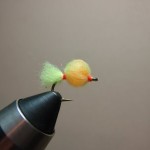
Hook: Tiemco #105 Size 10
Egg: Otter’s Egg 6mm Opaque Apricot
Sheath: Chartreuse Egg Yarn
I saw this pattern in a magazine or a book several months ago and liked the looks of it. You can use a plastic bead, metal bead, or Otter’s Eggs. Mix and match the colors of the beads and yarn for a variety of color combinations. I’ll let you know how they work this spring!
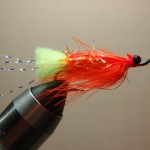
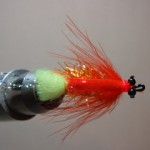
PS HEX NYMPH
Hook: Mustad Black Salmon – Size 6
Tail: 4-6 strands Krystal Flash
Overtail: Chartreuse glo-bug yarn
Body: Orange large cactus chenille
Rib: Orange saddle hackle
Shellback: Orange Edge-Brite
Eyes: Mono eyes
I picked up this pattern at the Norther Angler in Traverse City a couple of summers ago. I added the Krystal Flash tail and changed the shellback from glo-bug yarn to Edge-Brite. Other successful colors are all pink and a chartreuse body with an orange shellback and overtail. I have used this pattern with great success on the PM and the waters in the local area. Tie some up this winter and give them a try next spring!
SJRVFF Fly Tiers – I would like to get this part of the website going forward in a big way but I need your help! Send me one or more of your favorite fly patterns – they don’t have to be something you created. Send me what you like to use whether it be a pattern from the 1940’s or a pattern you picked up at a fly shop this summer and it worked good for you. All I need is a color photo, pattern receipe, the tying instructions, and I will take it from there. This club has many great fly tyers , so take the time to share your favorites with the rest of us!!!!
Eric Wroblewski
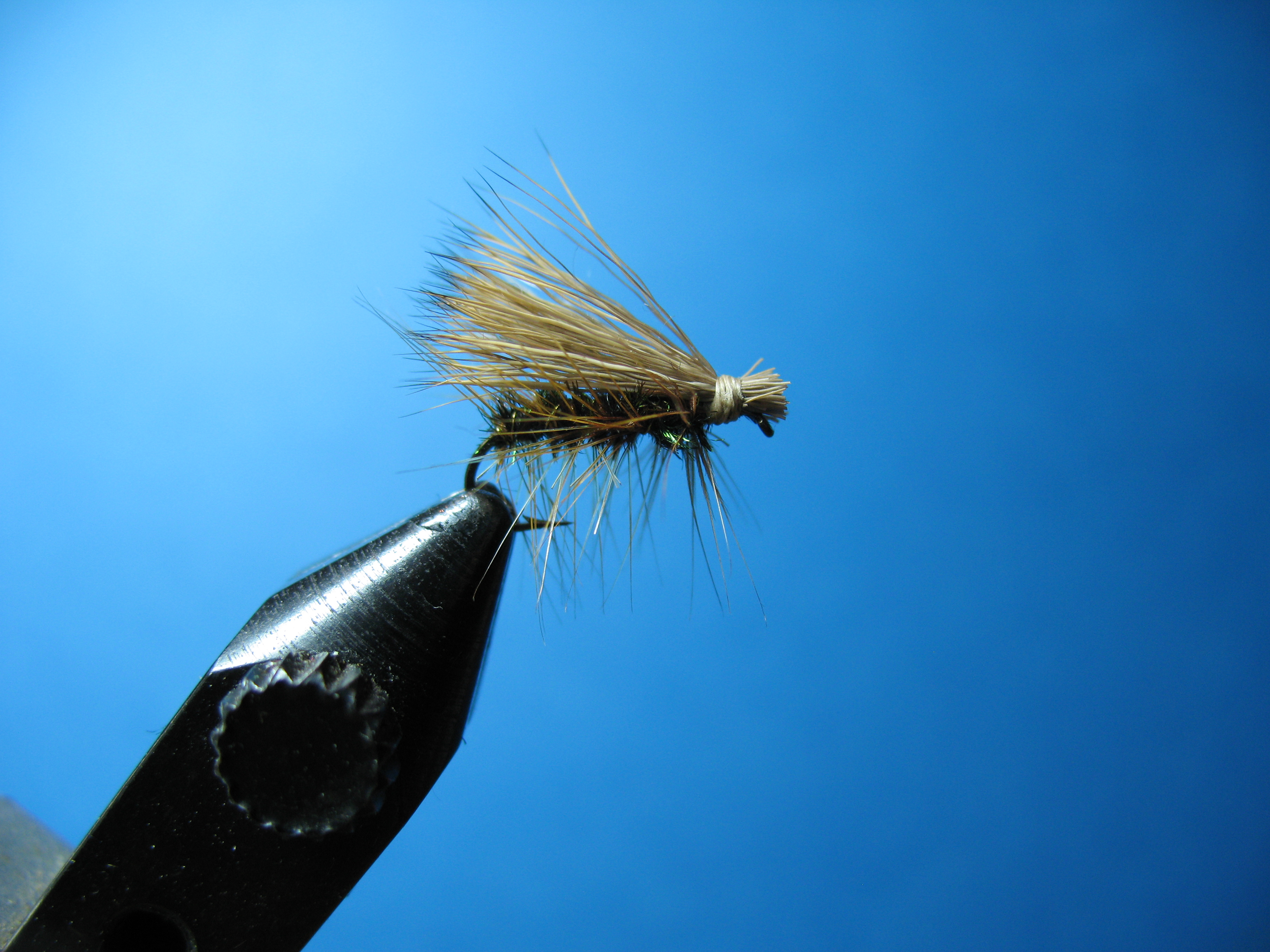
Elk Hair Caddis – Peacock Style
Caddisflies are a very prolific aquatic insect and are an important bug to the fly fisher. They come in many varieties. Compared to the mayfly, the mayfly has 200 species in 30 genera and 12 families while the caddisfly has roughly 1400 species, 147 genera, and 22 families.
A number of Michigan stream hatch charts show caddisfly hatches occurring from late April through the end of August, with hatches generally occurring in the afternoons. On the Au Sable, the olive caddis starts in the third week of May and continues to the end of August.
The elk hair caddis has been tied in many variations since Al Troth first originated the fly. One of the variations is to use peacock herl for the body. Peacock herl is a wonderful fish attractive material because of the various colors and hues it presents under various lighting conditions. There are also opportunities for other variations with the proliferation of new synthetic materials that have come on the market recently. One of these materials that I plan to experiment with is to use ice dubbing for the body.
The elk hair caddis is a dry fly and needs to be fished like one. This means drag free drifts. However, don’t be afraid to fish the fly when there is no caddis hatch present. I have caught as many trout on the elk hair caddis without a hatch present as I have during a hatch. I have had my most success in the smaller sizes of 16 and 18.
Hook: Dry Fly Hook Sizes 14 – 18 (Mustad 94833 or TMC 100)
Thread: Brown or Tan 70 denier (Uni-Thread 8/0)
Body: Peacock Herl
Ribbing: Fine Gold Wire
Wing: Cream Colored Elk Flank Hair
Hackle: Ginger
Tying Instructions:
1. Attach thread and wrap to the hook barb. Attach fine gold wire.
2. Attach 3 – 4 strands of peacock herl by the tip at rear of hook.
3. Wrap thread around peacock herl and wrap body to within one hook eye of the front of the hook. Trim excess material.
4. Attach hackle of appropriate size by the butt end at the front of the hook.
5. Wrap hackle to rear of hook with open spirals. Tie off hackle with three wraps of the gold wire and trim the excess hackle.
6. Spiral wire to the front of the hook, taking care that you do not trap too many hackle fibers. Tie off wire and trim excess.
7. Prepare the elk hair by cleaning the under fur from a small bunch of elk hair (about the diameter of 1 – 2 match sticks depending on the size of the fly). Stack the elk hair and tie in immediately behind the hook eye. Keep a tight pinch on the elk hair while tying it in to ensure the elk hair stays on the top of the hook. The wing should extend to the back of the hook.
8. Whip finish and trim the butt ends of the elk hair even with the outer edge of the hook eye to represent the head of the insect.
April Vokey lives in British Columbia, and was born with an unexplainable passion for fishing. April is an avid angler and steelhead, salmon and trout guide. As a young girl she coaxed her father into going fishing and by the age of sixteen, when she was old enough to drive, she was devoting all of her free time to her local rivers. She is passionate about Spey casting to wild steelhead, the environment and tying Salmon/Steelhead flies. She has made it her mission to encourage and introduce aspiring anglers to the sport, in hopes that it will bring them as much pleasure as it has brought her. She takes pride in being an eternal student of fly-fishing and an active conservationist.
 April is a Federation of Fly Fishers Certified Casting Instructor and fly-fishing columnist. She is the founder and director of the popular fundraiser, Flies for Fins, and in 2011 she proudly joined the Patagonia ambassador team, where she continues to assist in the design and direction of an upcoming women’s line of fishing apparel.
November’s meeting date has been changed. We will be meeting on the first Wednesday this month as to avoid conflicting with Thanksgiving travel.
SJRVFF is moving our monthly meeting location. The new location is the Upper Deck inside of the Stanley Coveleski Stadium in downtown South Bend. (map)
Parking is in Parking Lot “A” on the NW corner of Taylor St. and South St. Please use main office entrance and not the gates to the stadium. Meeting times will remain the same- open at 6:30 pm, dinner at 7:00 pm with the meeting and speaker to follow dinner. The cost for dinner is now $10.00 per person and a cash bar will be available. Pease, no “BYOB”. I look forward to the new location better meeting our needs.
This month’s featured speaker is April Vokey.