News and Updates

2013 Fly Fishing Film Tour

Jeff, “Bear” Andrews along with Bear Handed Fly Designs/Guide Service will hosting the 2013 Fly Fishing Film Tour at the Lansing Capital City Regional Airport on Thursday March 7th at 7:15pm. For ticket information contact Bear at Jbearfly@aol.com. Or by phone at 517-290-7789 or you can go to the Fly Fishing Film tour Website www.thef3t.com. Tickets are $15 in advance, $18 on the website or$20 at the door.

Beachy’s Better Caddis (BBC)

img_1066ex

Beachy’s Better Caddis (BBC)
Hydropsyche; Non-Cased Caddis Larvae
By Mike Beachy

B B Caddis

Hook 200R TMC size 16
Thread Black 8/0
Tail Black Z-Lon
Ribbing Super Hair Olive or thin mono
Dubbing Spectrablend Dark Olive
Back 1/8” Scud Back Olive
Legs Black Plastic Bristle from work bench dust brush
Coloring Black and Green Sharpie Markers
img_1047ex

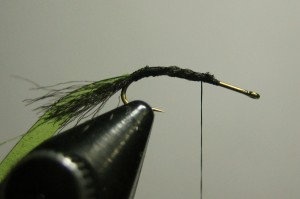
Step 1) Start the thread base 1/4 shank length back from hook eye leaving the front part of the shank bare. Tie in black Z-lon tail fibers and a single strand of super hair ribbing material and let hang off the back. Trim scud back material into a long taper and tie in toward the back over the bend of the hook. You want to tie the fly down and around the curve of the hook to give the finished fly a curved look. The tail section will be smaller diameter then the front so you only want the scud back to wrap about half way around the body when you are done with no scud back covering the belly portion.
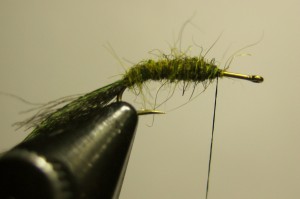
img_1048ex< Step 2) Dub the body of the bug building a taper towards the 1/4 point where you started your thread. Try and keep the tail tip portion as skinny as possible. img_1050ex
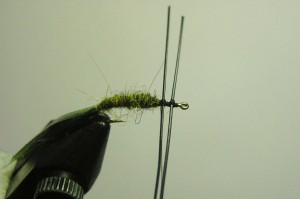
Step 3) Tie in two sets of legs using two plastic bristles cut from a work bench dust brush. I purchased a dust brush from Menards for a couple bucks with enough bristles to last me 10 lifetimes. Chances are good that you have something similar in your garage that will work. The plastic fibers work well since they can be bent and they maintain the shape with very little memory spring back. Tie the first at the 1/4 point then the second, half way between the first and the hook eye. Leave the legs long and straight for ease in tying the rest of the fly. The legs should look like two airplane wings sticking out from the hook shank, perpendicular to the shank and parallel to each other.
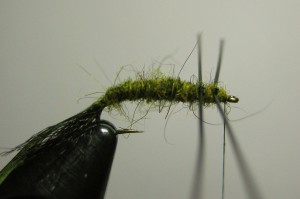
img_1053ex

Step 4) Dub the remaining shank in a descending cone toward the hook eye around and between the legs using the same dubbing as prior.
img_1056ex

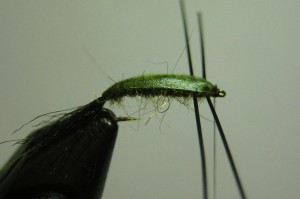
Step 5) Pull stretch scud back material forward over the back of the bug and tie it off behind the hook eye. Take the super hair fiber (or small mono line) and spiral wrap 8 to 10 segments over the scud back. Pull firmly downward across the scud back to make indentations without rotating the scud back off the back of the fly. Segment the entire length forward between the legs and tie off behind the hook eye.
img_1060ex

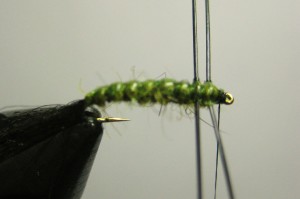
Step 6) Tie a small black head with thread. Finish, trim thread and glue head of fly.
img_1062

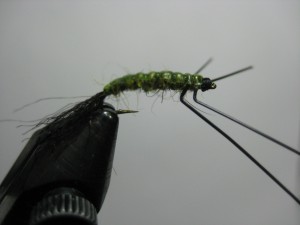
Step 7) Bend the plastic legs straight down on each side of the body towards the belly. Using a forceps or tweezers bend the legs forwards to create an elbow. The legs should end up pointing towards the hook eye and slightly outwards. Cut excess leg material off.
img_1066ex

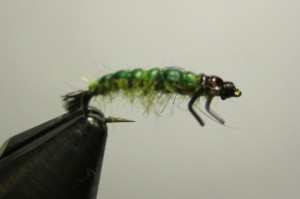
Step 8) Trim the Z-lon tail into a short little brush. Use a black permanent marker to blacken the first two or three back segments of scud back material behind the head. Do not go beyond the legs. You can darken the remaining scud back with a little green or brown marker if you so desire. Pick out the dubbing material in the belly of the abdomen to represent the gills. Leave gills short by trimming longer dubbing hairs.
img_1071ex

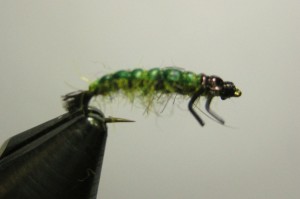
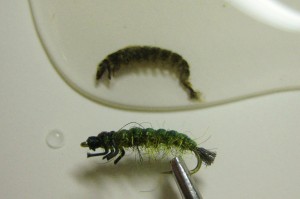
Finished fly looks very lifelike. In the photo you can see the fly next to a real free swimming caddis. These caddis spin a web to catch floating food and many times get dislodged from their perch and dangle in the current by their web much the same as this fly dangling from your tippet.
TERRESTRIAL FLY TYING CLASS WITH GLENN WEISNER

FEBRUARY 16, 2013– ELKHART CONSERVATION CLUB (MAIN BUILDING)
9:00 a.m – 4:00 p.m.
$50.00 PER PERSON – LUNCH AND SOFT DRINKS INCLUDED
Glenn hails from Toledo, Ohio and is the owner of Glenn River Fly Co. He was the speaker at our March 2012 meeting and his program was on Terrestrial insects for the fly fisher. We will be tying 5 – 7 terrestrial patterns that you will be able to use in our area for trout, bass, and panfish.

Glenn WeisnerClass participants are expected to have basic tying skills as this will be an intermediate skill level class. You will need to bring heavy and light tying threads in several colors, vise, tying tools and a light. The tying materials will be provided.
The class size will be limited to 20 fly tyers. If you are interested in taking the class please email Eric Wroblewski or call 574-850-5441.
If you would like more info about Glenn please visit his website.

SJRVFF Terrestrial Fly worskop FAQs

Ed McCoy


Captain Ed McCoy grew up in Northern Michigan fly fishing for trout, salmon, and steelhead. Ed attended Michigan State University and graduated with degrees in Zoology and Fisheries & Wildlife.  While attending MSU he worked on several research projects studying stream ecology and fish biology throughout Northern Michigan.  After graduating from MSU he Ed McCoywas involved in post graduate research studying salmonid recruitment in the Muskegon River through the University of Michigan.  He was very fortunate throughout his college years to be able to study (and play) on some of our more notable rivers such as the Au Sable, Manistee, Muskegon, Pere Marquette, and Pine Rivers. His background can offer a very unique perspective into fishing our local fisheries as his education and time spent on the water provides a comprehensive insight into our fisheries regarding every aspect from the habitat to the behavior of the fish we pursue. www.hawkinsflyfishing.com

Beginner Tying Class Offered

The St. Joseph River Valley Fly Fishers (SJRVFF) is hosting a Beginning Fly Tying Class. The classes will be at the Kroc Center in South Bend, located at 900 W. Western Ave. Classes will be on Tuesday nights from 7:00pm to 9:00pm beginning February 3rd and running for seven weeks. This year’s classes will focus on beginning fly tying. The first class will review the tools of fly tying and we’ll begin tying the later half. Each class and pattern following will build on the previous week’s techniques. Participants will be able to tie most of their own flies at the end of the classes. The SJRVFF will provide all necessary fly tying materials and tools but participants are welcome to bring their own tools if they have them.

The cost for non-members of SJRVFF is $30.00. For members of SJRVFF the class cost is $5.00. Money will be collected at the first class. The class will be limited to 30 people. For questions or to reserve your spot contact Dustin New at dustinew@sbcglobal.net or Jeff Stanifer at janar3@sbcglobal.net.

Gary Krebs – Tying Class January 19th, 2013

Gary Krebs will be with us on January 19th, 2013 for a one day fly tying seminar at the Elkhart Conservation Club.  Gary is located in West Lafayette, IN. and has come up with some very interesting ways of tying poppers. The cost for this seminar is $50.00 and is open to all who want to attend. Participants, however, will need to already have basic fly tying skills.

Tiers will need to bring there own vise, tools, lamp (if needed), and thread. Lunch and materials are included in the class fee.  The seminar will start at 9:00 am and should conclude by 4:00 pm with a break at noon for lunch. Please contact Todd Ezzell at m3plus2@hotmail.com or 574-202-0255 if you need more information or would like to reserve a spot. This seminar will be limited to 16 tiers.

Gary has a couple You Tube videos that you may want check out.

December Meeting

Good food, good drink…. Great company! You do not want to miss
the annual SJRVFF awards and Story Night. We will be handing out
Fly fisher of the Year, Tyer of the Year, Oakie Drifter and more!

Members will then share some of their memories and funny stories
of fishing trips past. Expect a lot of laughs. This tradition has
become a club favorite of many members!